Thinking about Computation as a Physical Process
計算という過程を、物理から考える
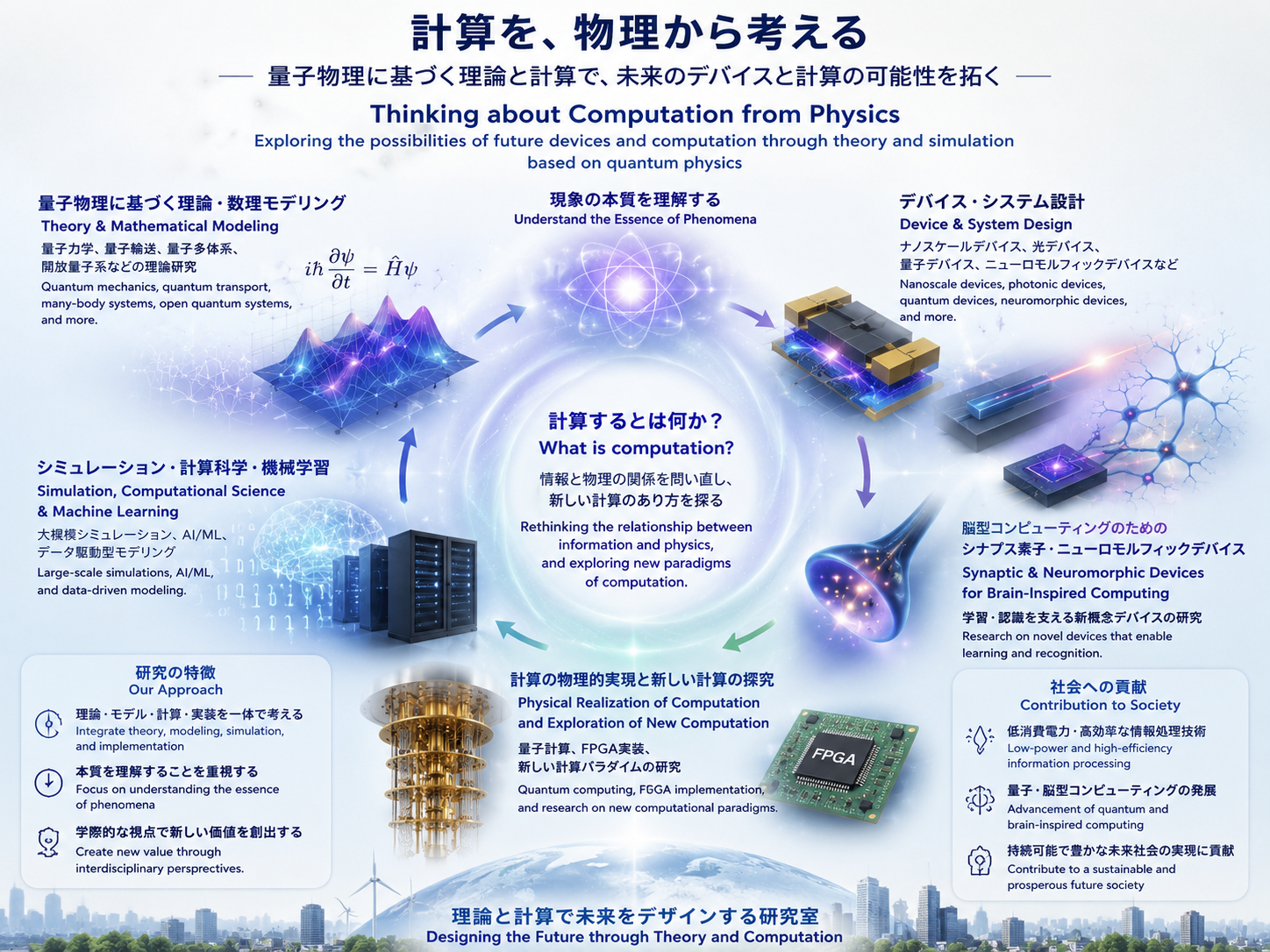
神戸大学ナノ構造エレクトロニクスEP4A研究室では、量子物理学に基づく理論、数理モデリングおよび計算科学的手法を用いて、ナノスケールの半導体デバイスから、光デバイス、脳型コンピューティングのためのシナプス素子、量子デバイス・量子システムに至るまで、その動作原理を明らかにし、新しい材料、構造、制御方法および情報処理原理の創出につなげる研究を行っています。
私たちが重視しているのは、単に既存のデバイスやアルゴリズムの性能を計算することではなく、その背後にある物理現象を理解し、「なぜそのような振る舞いが生じるのか」「どのようなモデルによって現象の本質を捉えることができるのか」を考えることです。そのため、量子輸送理論、原子論的電子状態計算、開放量子系、数値計算法、機械学習、量子回路およびハードウェア実装などを相互に結びつけながら研究を進めています。
これらの研究の背景には、計算を単に数値を求めるための操作や、現象を予測するための道具として捉えるのではなく、物理系の中で実現される一つの過程として捉えるという共通の視点があります。ここでいう計算には、状態の表現と変換、情報の流れ、記憶、測定および制御が含まれます。数理モデルによって記述された過程が、現実の物理系の中でどのように実現されるのかを考えることは、数値シミュレーション、量子計算、機械学習、FPGA上への計算過程の実装など、一見異なる研究をつなぐ問いでもあります。
研究対象は、ナノ・半導体デバイス、新材料デバイス、光デバイス、シナプス素子などのニューロモルフィックデバイス、半導体量子ビット、量子ダイナミクス、量子数理モデルなど多岐にわたりますが、いずれの研究においても、物理的実体、数理モデル、計算方法およびデバイス実装の関係を一貫して考えることを大切にしています。個々の研究課題に取り組むと同時に、「計算とは何か」「計算という過程は物理系の中でどのように成立するのか」という問いについて考え続けることを、当研究室の研究姿勢の一つとしています。研究内容の詳細については、Researchをご覧ください。
Research Training
ナノ構造エレクトロニクス研究室では、日々の研究活動、研究室ミーティング、論文作成および学会発表などを通して、専門知識を身につけるだけではなく、自分自身で問いを立て、理論や計算方法を組み立て、得られた結果を検証し、それを他者に分かりやすく説明するための力を養うことを重視しています。
研究は、あらかじめ与えられた課題に対して答えを求めるだけの活動ではありません。何を問題として捉えるのか、どのような視点から対象を切り取り、どのような数理モデルや計算方法を用いるのかを考えること自体が、研究の重要な一部です。そのため、研究室内での議論や教員との対話を通して、それぞれの学生が自分自身の考えを深めていくことを大切にしています。
卒業研究生として配属した学生に対しては、研究室でこれまで行ってきた研究テーマの流れをそのまま当てはめるという考え方はしておらず、まず、自分がどのようなことに興味を持ち、何を明らかにしたいと考えているのかを掘り下げてもらいます。その関心は、最初から当研究室の研究分野に直接結びついている必要はありません。自分自身の関心を出発点として、教員との対話を重ねながら、科学技術研究として取り組むことのできる問いへと育てていきます。
大学院へ進学する学生に対しても、進学そのものを目的とするのではなく、自分が本当に研究したいことは何か、そのためにどのような研究環境を選ぶべきかを考えることを重視しています。
Thinking about Computation as a Physical Process
At the Nanostructure Electronics EP4A Laboratory, Kobe University, we investigate the operating principles of nanoscale semiconductor devices, photonic devices, synaptic devices for brain-inspired computing, quantum devices, and quantum systems by using theories based on quantum physics, mathematical modeling, and computational approaches. Through these studies, we aim to contribute to the creation of new materials, structures, control methods, and principles for information processing.
Our aim is not simply to calculate the performance of existing devices or algorithms. We place importance on understanding the physical phenomena behind them and on asking why a particular behavior occurs and what kind of model can capture the essential nature of the phenomenon. For this purpose, we connect quantum transport theory, atomistic electronic-structure calculations, open quantum systems, numerical methods, machine learning, quantum circuits, and hardware implementation.
Underlying these studies is a common perspective: computation is not merely a numerical operation or a tool for predicting phenomena, but a process physically realized within an actual system. In this sense, computation includes the representation and transformation of states, information flow, storage, measurement, and control. Considering how a process described by a mathematical model is realized in a physical system provides a common question connecting research areas that may at first appear different, including numerical simulation, quantum computation, machine learning, and the implementation of computational processes on FPGA.
Our research covers a wide range of topics, including nanoscale semiconductor devices, emerging-material devices, photonic devices, synaptic and neuromorphic devices, semiconductor qubits, quantum dynamics, and quantum mathematical models. In all of these studies, we place importance on consistently considering the relationship among physical systems, mathematical models, computational methods, and device implementation. Alongside individual research topics, we also continue to ask what computation is and how a computational process can arise within a physical system. For further details, please see the Research page.
Research Training
Through daily research activities, laboratory meetings, paper writing, and conference presentations, we aim not only to develop advanced knowledge in specialized fields, but also to cultivate the ability to formulate questions, construct theories and computational methods, examine the results obtained, and explain them clearly to others.
Research is not merely an activity of finding answers to problems that have already been given. Deciding what should be regarded as the problem, how the subject should be viewed, and what mathematical model or computational method should be used is itself an important part of research. We therefore place importance on discussion within the laboratory and on dialogue with faculty members, through which each student can deepen their own thinking.
For undergraduate students beginning their graduation research, we do not simply assign topics by continuing the existing line of research in the laboratory. We first ask each student to examine what they are interested in and what they genuinely wish to understand. Their initial interests do not necessarily have to be directly related to the current research fields of the laboratory. Starting from those interests, students develop questions that can be pursued as scientific and technological research through continuing dialogue with faculty members.
For students considering graduate study, we also place importance not on entering graduate school itself as the goal, but on considering what they truly wish to study and what kind of research environment is appropriate for that purpose.