
GEPP Co-hosted an International Seminar on “Why Do We Need Still Basic Education for Education Development in Africa?”
 gepp1
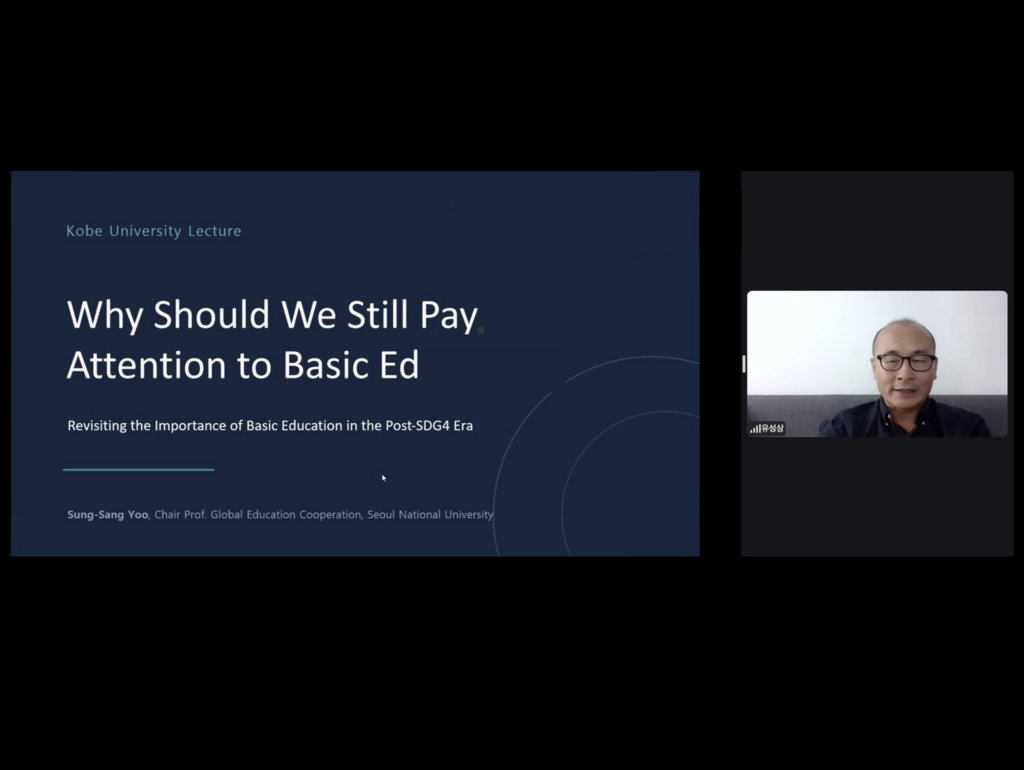
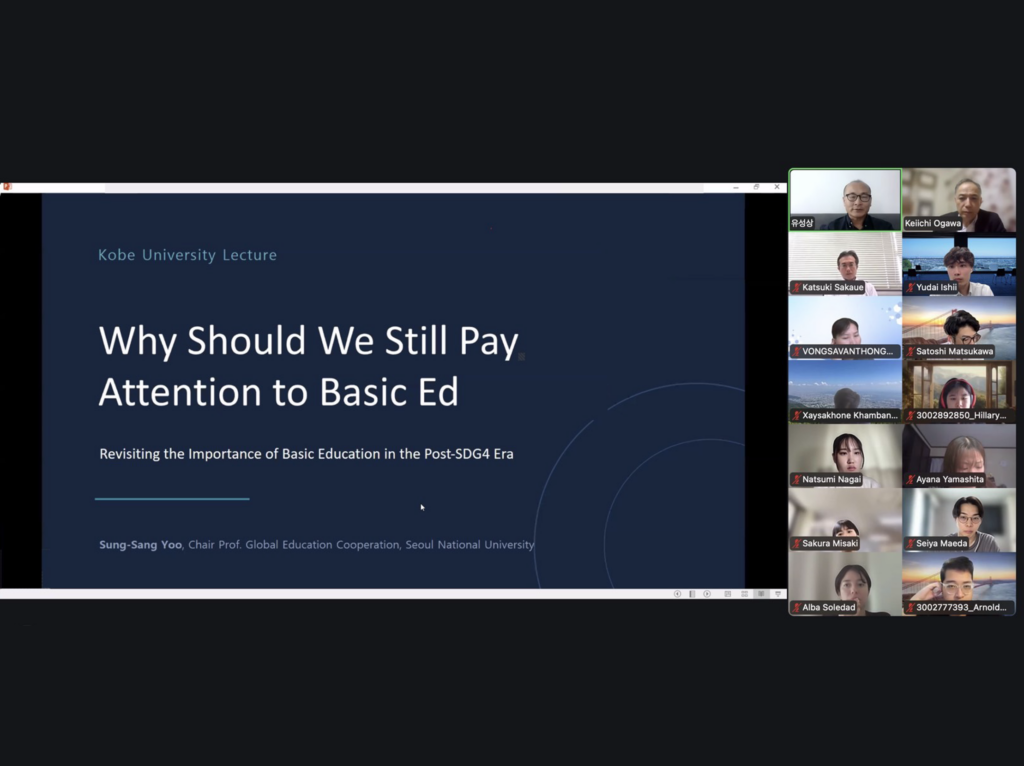
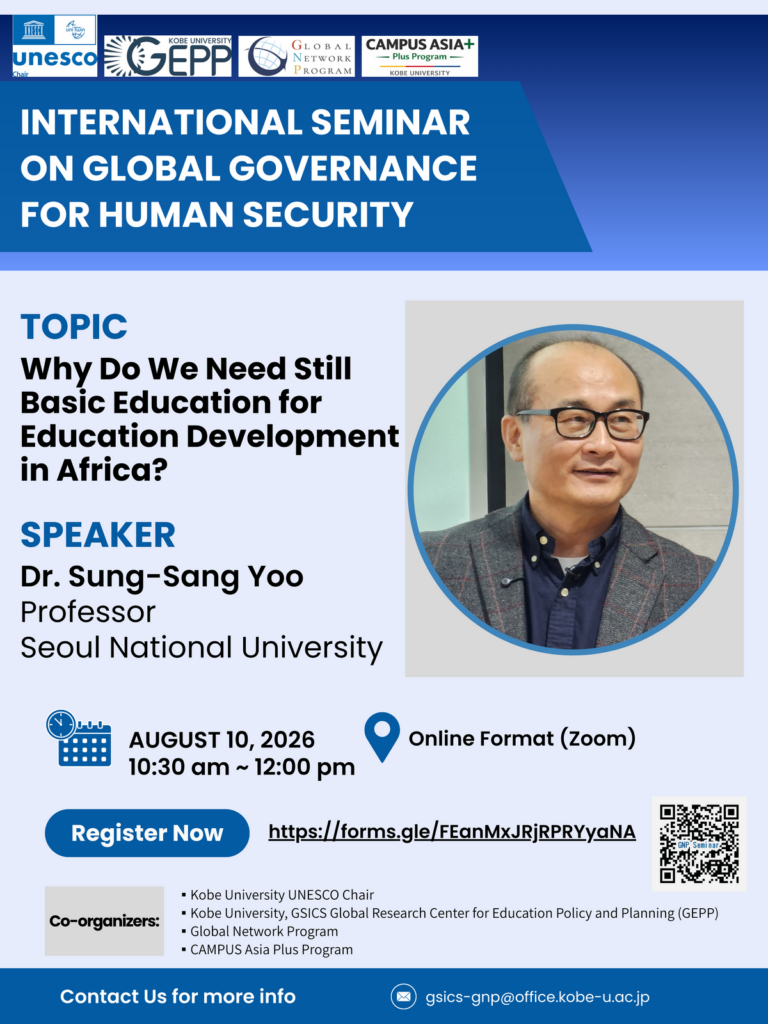
gepp1On August 10, 2026, the International Seminar on Global Governance for Human Security was held under the theme “Why Do We Need Still Basic Education for Education Development in Africa?” The seminar was conducted online and co-organized by the Global Research Center for Education Policy and Planning (GEPP), the Kobe University UNESCO Chair, the Global Network Program, and the CAMPUS Asia Plus Program.
The seminar featured Dr. Sung-Sang Yoo, Professor at Seoul National University in the Republic of Korea. He began by tracing shifts in the global education agenda, from Education for All (EFA) to SDG4 and, more recently, to digital and skills development, artificial intelligence, and future competencies. At the same time, he highlighted a decline in the relative priority given to basic education in international development assistance, including a decreasing share of basic-education aid directed toward low-income countries. Despite these shifts in global policy and financing, the learning crisis remains unresolved: 70 percent of 10-year-olds in low- and middle-income countries are unable to read and understand a simple text, while learning poverty remains particularly severe in Sub-Saharan Africa. These trends demonstrate that basic education cannot be regarded as a “finished” agenda.
The lecture then examined Mozambique as a case illustrating how expanded access to schooling does not necessarily guarantee learning. Following the 2018 education law reform, Grades 1–9 were redefined as compulsory basic education, with a transition toward integrated nine-year basic schools. Nevertheless, major challenges remain, including low primary completion rates, serious teacher shortages, and weak learning outcomes. Drawing on field observations, Dr. Yoo contrasted schools facing unfinished classrooms, shortages of desks and chairs, and classes conducted in inadequate spaces with schools equipped with appropriate classrooms, sanitation facilities, and functioning school-management systems. These examples illustrated the broader problem of “schooling without learning,” in which expanded access is not matched by adequate infrastructure, financing, teacher systems, curricula, and institutional capacity. The lecture therefore emphasized the importance of establishing minimum learning-quality standards, reforming teacher qualification and professional-development systems, improving curriculum and assessment in an integrated manner, and building stable education-finance governance.
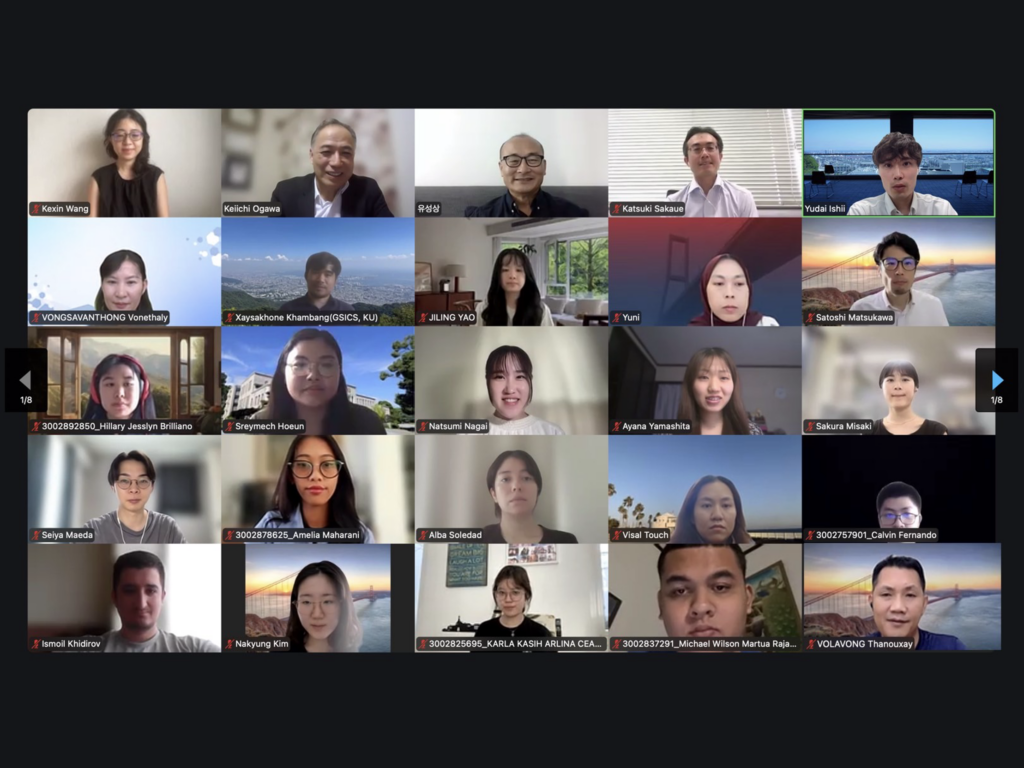
Approximately 200 online participants attended the seminar. During the question-and-answer session, participants actively exchanged views on how basic education should be positioned amid the growing attention to emerging agendas such as digitalization and artificial intelligence, how expanded access to schooling can be accompanied by improvements in learning quality, and how challenges related to teacher shortages, school infrastructure, and education financing can be addressed in Sub-Saharan African countries, including Mozambique. The discussion also touched on the significance of understanding education not merely as the acquisition of knowledge and skills, but as a capability that expands people’s freedom to make meaningful choices in their lives. The seminar provided a valuable opportunity to reaffirm that, even as new educational agendas such as digitalization and AI continue to evolve, quality basic education remains an essential foundation for education development and a critical priority in the post-SDG4 era.