
GEPP Co-hosted an International Seminar on “Higher Education Policy, Planning, and Implementation in Lao PDR”
 gepp1
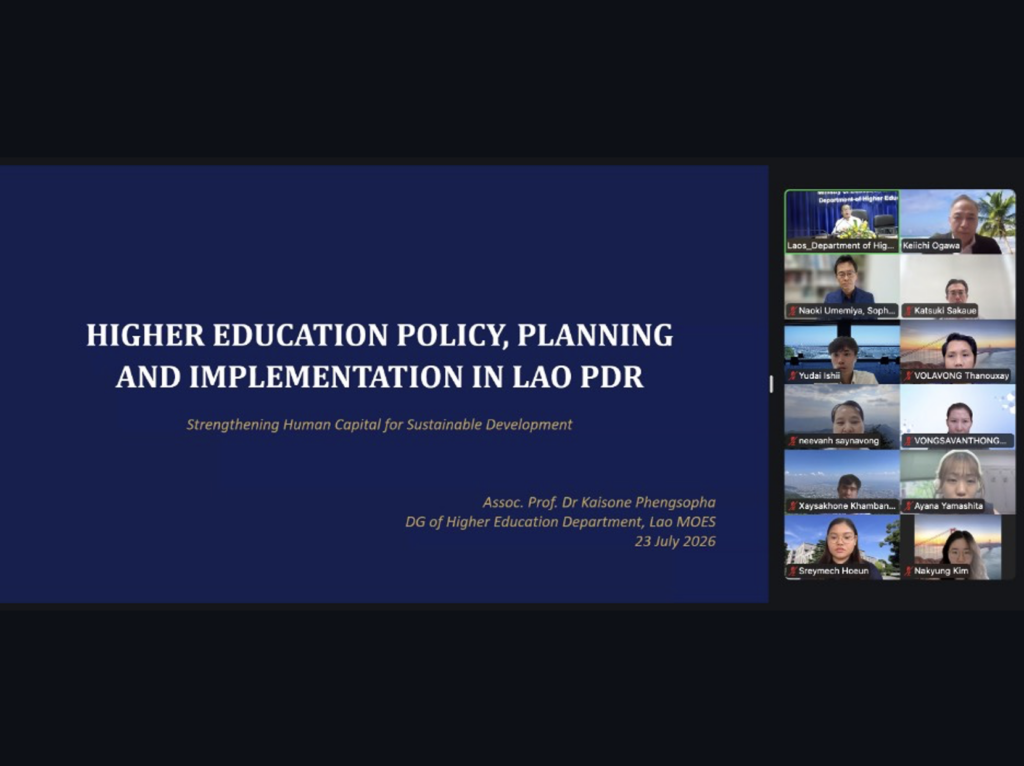
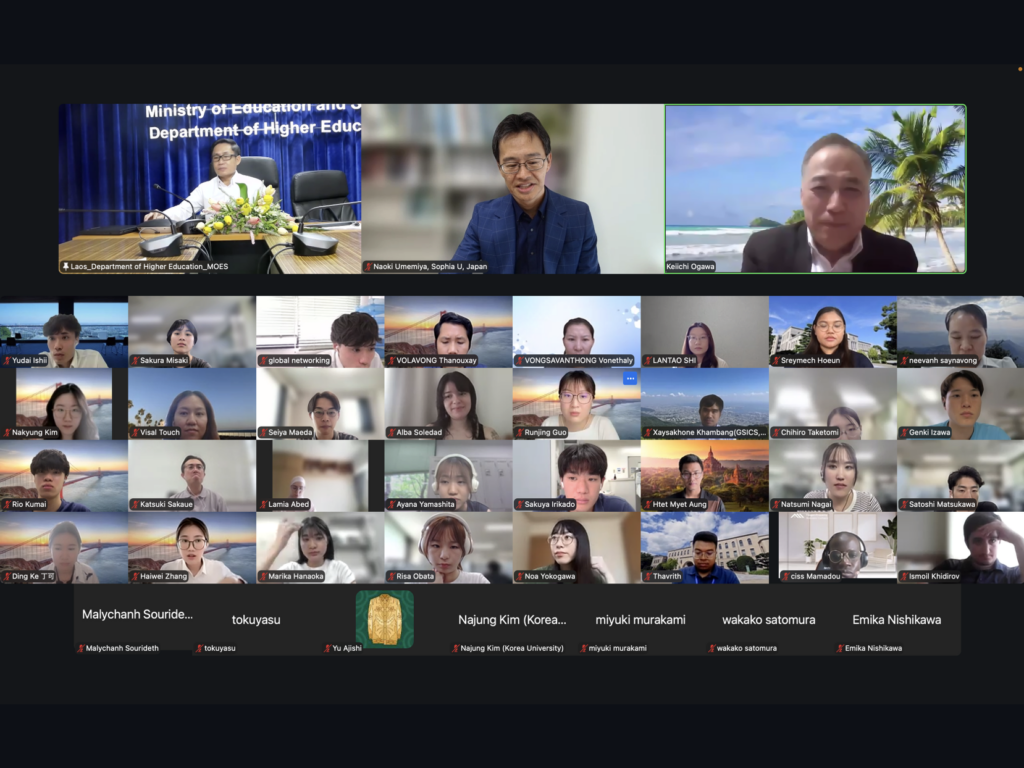
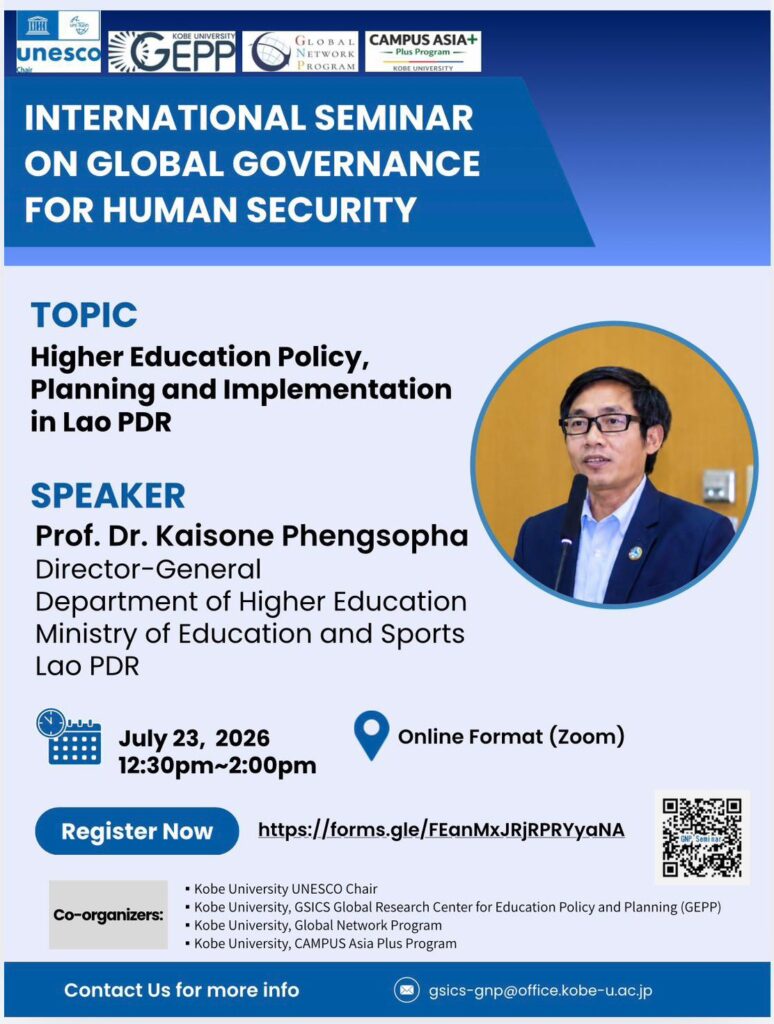
gepp1On July 23, 2026, an International Seminar on Global Governance for Human Security, titled “Higher Education Policy, Planning, and Implementation in Lao PDR,” was held in a hybrid format. The seminar was jointly organized by the Graduate School of International Cooperation Studies at Kobe University through the UNESCO Chair on Education for Gender, Disaster Resilience, and Well-being; the Global Research Center for Education Policy and Planning (GEPP); the Global Network Program (GNP); and the CAMPUS Asia Plus Program.
The seminar welcomed Dr. Kaisone Phengsopha, Director-General of the Department of Higher Education at the Ministry of Education and Sports (MoES) of Lao PDR. In his presentation, Dr. Phengsopha outlined the role of higher education in Lao PDR's national development. The country has 29 higher education institutions, a total enrollment of approximately 15,000 students, and a tertiary progression rate of around 30%.
Dr. Phengsopha presented Lao PDR’s higher education policy framework, extending from the Constitution and the Education Law to the ESSDP, the NSEDP, and the Higher Education Development Strategy. He also discussed the three-tier planning process at the national, institutional, and faculty levels; key implementation partners, including MoES, universities, provincial authorities, and development partners such as the World Bank, ASEAN, UNESCO, and JICA; and the country’s internal and external quality assurance systems.
The achievements highlighted during the presentation included increased enrollment, female student accounting for 51% of total enrolment, improved access to ICT, expanded scholarship opportunities, and stronger partnerships with ASEAN, JICA, KOICA, DFAT, and the World Bank. The principal challenges identified included funding constraints, a shortage of faculty members holding doctoral degrees, a mismatch between graduate skills and labor-market needs, urban-rural disparities, and limited collaboration with industry. Dr. Phengsopha presented ten recommendations covering short-, medium-, and long-term priorities. He concluded with the message that "investing in higher education is investing in the future of Lao PDR."
A total of 42 students, faculty, and staff participated. During the Q&A session, participants raised questions about international students and funding organizations. Dr. Phengsopha identified JICA, KOICA, DFAT, the ASEAN University Network, the World Bank, and UNESCO as key providers of scholarships and financial support. In response to a question about enrollment growth, he highlighted increasing demand in the IT sector and rising enrollment in STEM fields, while noting that overall growth remained gradual. The seminar offered participants with a valuable opportunity to gain a concrete understanding of the current conditions, policy priorities, and challenges facing higher education in Lao PDR.