


Research Divisions
Water Treatment Membrane Division
We develop separation membranes for water treatment, which have been industrialized in various forms—such as hollow fiber membranes for purifying tap water, reverse osmosis membranes for seawater desalination, and separation membranes for filtering industrial wastewater—and these membrane technologies play an important role in our daily lives.
Based on this background, the Water Treatment Membrane Research Division aims to establish the scientific foundations necessary to further enhance the performance of water treatment membranes. Building on this foundation, the division pursues engineering approaches and social implementation to realize highly functional membranes. Another important objective is to generate new scientific insights from advanced water treatment membranes.
The research themes of each team are as follows:
・Molecule-Scale Characterization Methods at Liquid-Solid Interfaces (Onishi)
・Energy Conversion and Recycling of Animal and Food Biomass Using Separation Technologies (Ihara/Yoshida)
・Development of nanosheet-layered membranes with 2D nanochannels (Matsuyama/Guan)
・Development of novel water treatment process based on forward osmosis(Matsuyama/Matsuoka)
Members
- Hiroshi Onishi (Professor) (Division Head)
- Ikko Ihara (Professor)
- Hideto Matsuyama (Project Professor)
- Gen Yoshida (Associate Professor)
- Kecheng Guan (Associate Professor)
- Atsushi Matsuoka (Assistant Professor)
- Zhaohuan Mai (Project Associate Professor)
- Mengyang Hu (Project Assistant Professor)
Research Topics
Molecule-Scale Characterization Methods at Liquid-Solid Interfaces
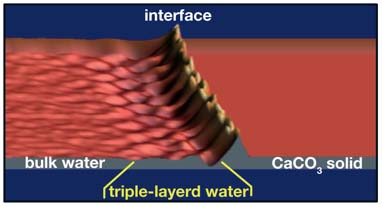
We are proud of our international-compatible studies of liquid-solid interfaces with advanced scanning probes, atomic force microscopy and electrochemical microscopy. Collaboration with foreign researchers and students are welcome in broad research area including applied chemistry, physics, geoscience, materials and mechanical engineering.
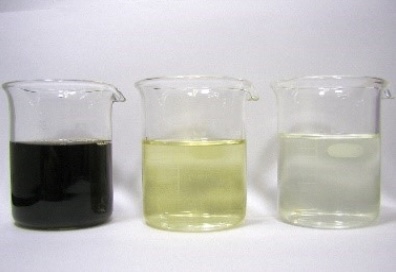
Energy Conversion and Recycling of Animal and Food Biomass Using Separation Technologies
Development of novel water treatment process based on forward osmosis(Matsuyama/Matsuoka)
- Hideto Matsuyama
- Atsushi Matsuoka
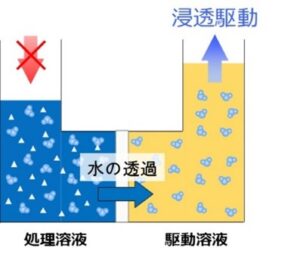
Fig. 1 Diagram of the nanosheet membrane with nanochannels
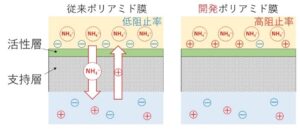
Fig. 2 Illustration of the forward osmosis membrane with high ammonium ion rejection
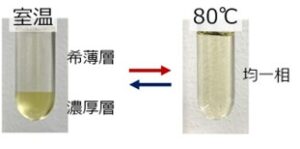
Fig. 3 Draw solution with USCT-type thermo-responsive phase separation property
In recent years, a forward osmosis (FO) process has attracted attention as a novel water separation technic for a desalination process or a process for concentrating foods, beverages, food additives, and bioproducts. In the FO process, water molecules permeate through a semipermeable membrane from a feed solution (FS) with lower osmotic pressure to a draw solution (DS) with a higher osmotic pressure. The driving force for water permeation in the FO process is the osmotic pressure difference between the DS and the FS (Fig. 1). Thus, the FO process requires neglectable energy for the water permeation compared to a conventional reverse osmosis (RO) process requiring a high pressure. Our group developed the FO membranes with high ammonia rejection (Fig. 2) and the DS with thermo-responsible materials (Fig. 3).
Development of nanosheet-layered membranes with 2D nanochannels (Matsuyama/Guan)
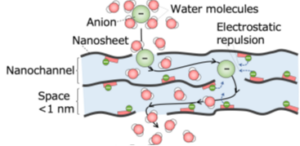
Fig. 1 Diagram of the nanosheet membrane with nanochannels
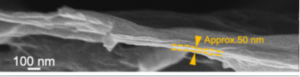
Fig. 2 Scanning Electron Microscope image of the nanosheet membrane developed through this research
Membrane separation is attracting attention as an energy-efficient technology for water purification, desalination, and ion-selective separations. Our group develops advanced membranes using two-dimensional nanosheet materials such as graphene oxide, where precise control of interlayer spacing and pore-wall chemistry enables selective molecular and ionic transport. Moreover, these membranes with well-defined nanochannels serve as a research platform for gaining fundamental insights into ion transport behavior within confined nanoscale spaces.
